Highlights:
Brazilian Forest Service (SFB) ALS Data available on the MAAP (Collection: ALS_CHM_Amazon_SFB) - Processed as per GCA chain. Available on MAAP. A big thank you to INPE and Daniel Braga for making the data available and helping us to ingest it in the MAAP platform
QWG#2 took place at CESBIO (Toulouse) on 30 Sept.-2 Oct. One objective of the meeting was to discuss potential evolutions of the INT phase set up.
On 22nd Oct (11:00 to 13:00 CET) the EEBIOMASS webinar series will start again with a session on "BIOMASS mission Calibration & Validation (Cal/Val) Activities".
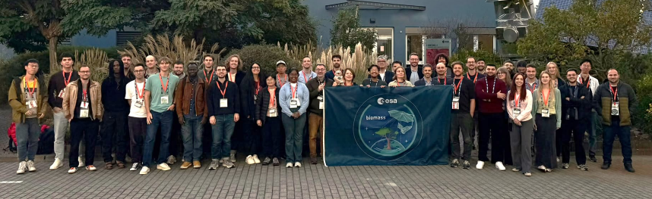
The 1st Biomass Hackathon started this week at ESOC. 38 Biomass enthusiast are working on Biomass analytical challenges during this week
Flight Operation Segment (FOS)
Spacecraft and ground segment: nominal
Executing nominal planning. Major Cycle #5 started on 14/09.
Timelines are at https://biomass-mpmf.org/timeline/, kml planning files are at https://earth.esa.int/eogateway/missions/biomass/documentation
Special operations:
One deleted X-Band downlink pass on 16.10. following a ground station request. No data was lost.
GNSS patch planned for CW#43 (20/10 GNSS-A, 22/10 GNSS-B). The patch addresses an update to the Position Quality Threshold identified after the Safe Mode in January 2026.
GNSS shows a decreasing trend of tracked SV over time. ARB to address this anomaly held on 22.09., behaviour understood and workaround under preparation. Until workaround is implemented on board, occasional restarts of the system might be necessary.
Mission Planning
Next ISRO launch with impact on Biomass acquisitions over India in CW#43.
OCM (Orbit Correction Manoeuvre) windows overlapping with datatakes from new acquisition mask: Affected primary data takes are being removed, impact only over ocean. Documentation to be aligned once this concept is finalised.
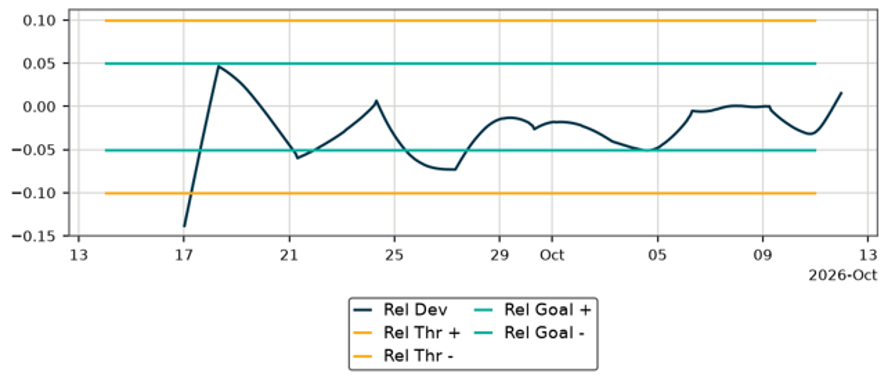
Absolute and relative ground track since start of MC#5:
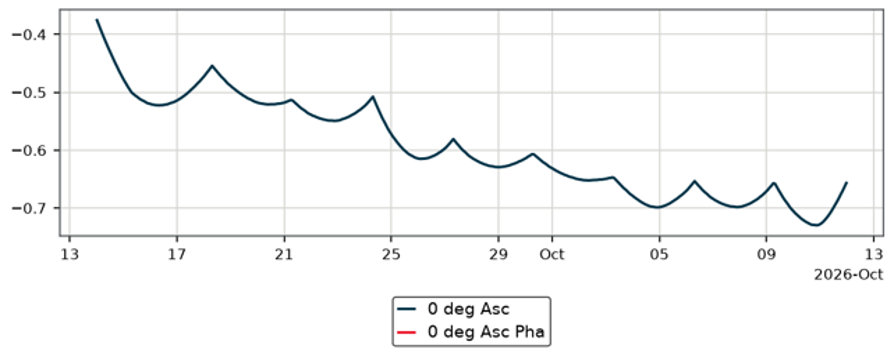
The top plot shows the absolute deviation in ground track between the reference orbit and the actual orbit. Each spike where the trend of the deviation is reversed shows an orbit control manoeuvre, which are executed every 3 days. Negative values show a deviation to the WEST, positive values show a deviation to the EAST.
The bottom plot shows the deviation of the relative baseline. This is the difference in ground track deviation between two overpasses over the same location, i.e. between orbit n and orbit n+44. The baseline drift in TOM is -887 meters (negative, since it is westwards). The plot shows how well this is maintained throughout the major cycle.
Example: A value of +50 meters in relative baseline deviation means that the actual difference in baseline was -887m + 50m = -837m for this orbit, so the baseline between two overflights was slightly shorter.
Satellite Maintenance and Anomaly Investigation
BIO_SC-25: Safe Mode due to GNSSFMON triggering on both GNSSR-A and GNSSR-B:
Regarding the drop in GNSS Satellite visibility issue:
A follow-up ARB to cover the GNSS SV issue was held on 22/09/2026. The current mitigation to reboot GNSR to recover up to 12 Satellite SV's in case of need remains in place.
BGA has identified that the cause of the observed behaviour is related to the C/N0 adaption algorithm which adjusts the gain because of jamming that then results in the signals from those GNSS satellites being degraded so they are no longer selected. A fix has been identified by disabling this selection process. This is achieved by increasing the attitude TC's uncertainty to 30 degrees which results in a C/N0 uncertainty greater than 1.5 dB which ensures that the algorithm does not adapt the expected C/N0 and the satellites are not deselected. No patch is needed since this can be achieved via a S140 Parameter Management Service.
Regarding the PQI threshold Update.
The Software Release Note for MARS_2.0.1.1 with Parameter DB 8.8 and 2021-04 Update and PQI was received 29/09/2026. The SOR is in preparation by FOS for a planned execution on 20/10 (GNSS-A) and 22/10 (GNSS-B).
BIO_SC-27: BIOMASS SAR PDHU ASW update on 14 April - Anomalous PDHU pointer behaviour:
Some progress on DSI side currently under review by AIRBUS. Depending on the feedback we will plan a follow up ARB.
BIO_SC-29: Bus coupler error and SW error on deletion of TC's from the OPS schedule:
The questions and clarifications requested by FOS to determine what further investigation is possible and the estimated are under review at AIRBUS.
BIO_SC-30: Biomass FDIR Level 3 - PDHU SW Error:
The root cause of the software failure and Fatal Trap 7 remains under investigation by DSI.
Follow up BCT polarimetry discussions were held on 22/09 and 02/10. A probable explanation for the polarimetric behaviour has been identified and is currently undergoing testing on the Engineering Model (EM). The aim is to have a fix in place for the BCT Acquisitions planned at the end of this year. A follow up meeting to discuss the status of testing and next steps is scheduled on 16/10.
Payload Data Ground Segment
Acquisition downlink – nominal
Passes with RFI (Xband cross-talk) and station problems still occurring. But having no critical impact on science data availability. Problem has been escalated within SSC Space for further investigation.
Inuvik Station Electric Power System maintenance announced for 26/10 and 28/10 - no downlinks available for several orbits. The impact will be reduced, by reducing secondary coverages to avoid on board memory overflows.
Mission Planning – nominal
Processing (CPF for forward, HPF for forward/bulk, RPF for reprocessing/regeneration) - nominal:
Overall performance degradation on-going, due to storage performance issues. Investigation still on-going, tweaks and improvements continue.
BPS 4.4.5, L0P 1.21 in operations:
Minor issues still pending for all processors, nothing blocking.
Discussion on L0 (and consequentially L1) metadata is required on following issue: The Track number is calculated in unexpected manner; at the end of a RC, when some datatakes are taken from the orbit that overlaps both the next and previous RC, the Track is presented as 01 instead of 44. This can have an impact on user side when accessing a stack of images and searching for the wrong track. QWG Discussion not conclusive.
Forward processing - nominal:
Nominal at all levels (except performance issues). MC#5 on-going (S1 Stack/L2A, S2 L0/L1 on-going).
Reprocessing/Recovery - degraded:
Affected by performance degradation. Goal remains to process everything until the end of 2026 (potentially using dedicated Reprocessing service).
MC#1 and MC#2 reprocessing still on-going; IOC data reprocessing to be restarted once it is safe.
L0 with wrong geometry recovered (from IOC and MC1/MC2).
Dissemination – nominal
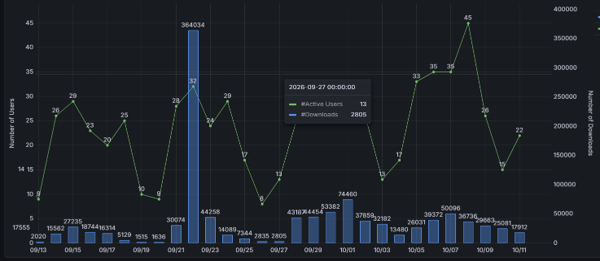
Fig: One month view. 1M downloads in total (peak - 300K products in one day by a UK user); active users ~30 per working day.
Archiving – nominal
Mission Algorithm and Analysis Platform
BPS integration on MAAP:
BPS V4.4.4 deployed up to L1C (4.4.5 fixes minor issue for forward processing only). L2A integration on-going.
Implementation of an integrated processor package (running L1 to L2A) is currently investigated.
Global Canopy Atlas ingestion almost complete. The GCA is described in https://www.biorxiv.org/content/10.1101/2025.08.31.673375v1 and will be shared openly on the MAAP once the paper is published.
Brazilian Forest Service (SFB) ALS Data now available on the MAAP (Collection: ALS_CHM_Amazon_SFB )- Processed as per GCA chain. Available on MAAP. A big thank you to INPE and Daniel Braga for making the data available and helping us to ingest it in the MAAP platform
NASA/ESA MAAP
Face to Face meeting planned for end October. Main topic of discussion are interoperability aspects - processing and delegated authentication.
Delegated authentication deployment ready and pending platform availability (simpler exchanges using ESA/NASA accounts on NASA/ESA services)
For those who want to work on the MAAP but don't know how, we made tutorial online:
Processor Evolution and Cal/Val (DISC)
QWG#2 took place at CESBIO (Toulouse) on 30 Sept.-2 Oct. One objective of the meeting was to discuss potential evolutions of the INT phase set up. Following points are under assessment and will be decided once a thorough impact analysis is available:
Extend the duration of the Satellite Repositioning Manoeuvre (SRM) from 9 to 15 days. This change will save fuel and allow to extend the mission lifetime while slightly extending the duration of a Global Cycle. In addition, this change will enable to acquire more data over ocean and desert targets.
Change the baselines progression for INT phase from 30% of the Bct to 15-20% of the Bct. This will improve the performance of the interferometric products.
Add one additional acquisition to the INT stack (i.e. 4 instead of 3 acquisitions). This will improve the performance of the interferometric products at the cost of extending the time required for Global coverage.
Optimise the acquisition masks for the INT phase. This involves applying the changes done during TOM also during INT.
Changing the swath used during the SRM from SW2 to SW3. This would be beneficial for the Ocean application and allow a better discrimination of polarimetric features.
Agree on a reprocessing schedule after the end of TOM phase
E2E test of the BCT for DES orbits failed:
Signal delays are different than for ASC pass, we are not sure whether this behaviour is expected.
A new warning was raised in FAUL.XML in addition of the “LowRemainingDisk” : “EmergencyStopAlarm” still present.
The pointing starts as expected (t=10:09:21, az= -44.07) but does not stops as expected ( t=10:09:21, az= -44.07 ; instead of t= 10:09:42, az= -63.975). Pointing stop values do not match with the “List_of_Antenna_Pointing_Angles” in the META.xml file. These values were matching in the previous overpasses.
Preparation of BPS V4.5 (to be delivered before the end of October). Following the QWG, additional bugs and improvements were implemented:
Increase of density of GCPs in GeoTIFFs
Calibration issue in L2A GN products
Two sources of crashes were identified and solved.
The support for the new AUX_TEC products is being added.
The behaviour related to the lack of AUX_TEC will be investigated and the impact on data quality will be assessed. A re-generation could be necessary.
Collection of reference data:
The ALS airborne campaign in Gabon is about to take place (some autorizations are still missing). There is a strong support from AGEOS (Gabonese space agency). ALS data will be collected for Mondah, Lope and Ipassa. The field campaign was concluded for in-situ and TLS data collection (GFZ).
Science and Campaigns
The 1st Biomass Hackathon started this week at ESOC. 38 Biomass enthusiast are working on Biomass analytical challenges during this week
Preparations Science and Validation Workshop (Edinburgh, April 2027)
Conference website to go live later this week.
AfriSAR-3 dataset processing:
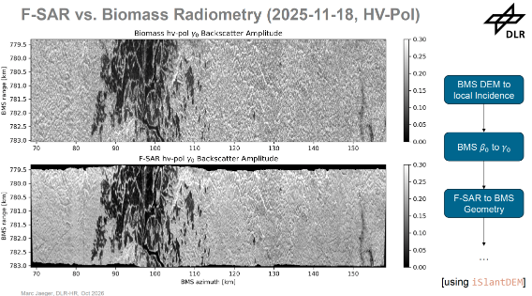
Radiometric issues due to F-SAR internal cal problems have been resolved using PS analysis comparison with AfriSAR-2 data over Libreville
Underflight analyses performed for several data showing excellent results (worth a webstory!):
The 19th EEBIOMASS webinar on "BIOMASS mission Calibration & Validation (Cal/Val) Activities" will introduce a variety of BIOMASS Cal/Val activities in two sessions:
Measuring the World's Forests: Cal/Val Projects for Biomass, Structure, and Disturbance is scheduled for the 22nd of October, from 11:00 to 13:00 CET .
Beyond the Trees: Transponder Calibration, Ionospheric Corrections, and Secondary Mission Objectives is scheduled for the 29th of October, from 15:00 to 16:30 CET .
Please, register here and feel free to pass the information along to your colleagues! Further information are available on our website: https://www.eebiomass.org/en/events/webinar.
AoB
none
Upcoming Meetings and Event
20 - 22 Oct: 4D Ionosphere workshop, ESRIN, Italy https://nikal.eventsair.com/4d-ionosphere/
22nd Oct (11:00 to 13:00 CET) 19th EEBIOMASS webinar on "BIOMASS mission Calibration & Validation (Cal/Val) Activities" Session 1.
29 Oct: Biomass Information Session at the "International Conference on Space and Sustainable Development", 27-29 Oct in Santiago de Chile, Chile.
28 - 30 Oct 2026 ASAR/RCM User Forum, Montreal https://www.asc-csa.gc.ca/eng/events/2026/2026-10-28-asar-rcm-users-forum.asp
29th Oct (15:00 to 16:30 CET) 19th EEBIOMASS webinar on "BIOMASS mission Calibration & Validation (Cal/Val) Activities" Session 2.
Cancelled: Oct: Biomass Workshop as part of the Thailand Space Expo (16-18th Oct) and Asia-Pacific Regional Space Agency Forum (27-30th Oct).
18 - 20 Nov: BioGeoSAR-2026, Barcelona, Spain https://indico.esa.int/event/640/
24 - 25 Nov: 1st Satellite In-Orbit Performance Review, Airbus Stevenage, UK (by invitation).
30 Nov - 4 Dec: CEOS SAR in Perth https://events.csiro.au/Events/2026/June/11/CEOS-SAR-2026
2 - 4 Dec, Electron Tomography workshop, Campinas, BR.
12 - 15 Apr 2027: 2nd Biomass Science and Validation Workshop, Edinburgh, UK. https://eo4society.esa.int/event/biomass-science-and-validation-workshop-2027/
15-16 April 2027: QWG#3 in Edinburgh