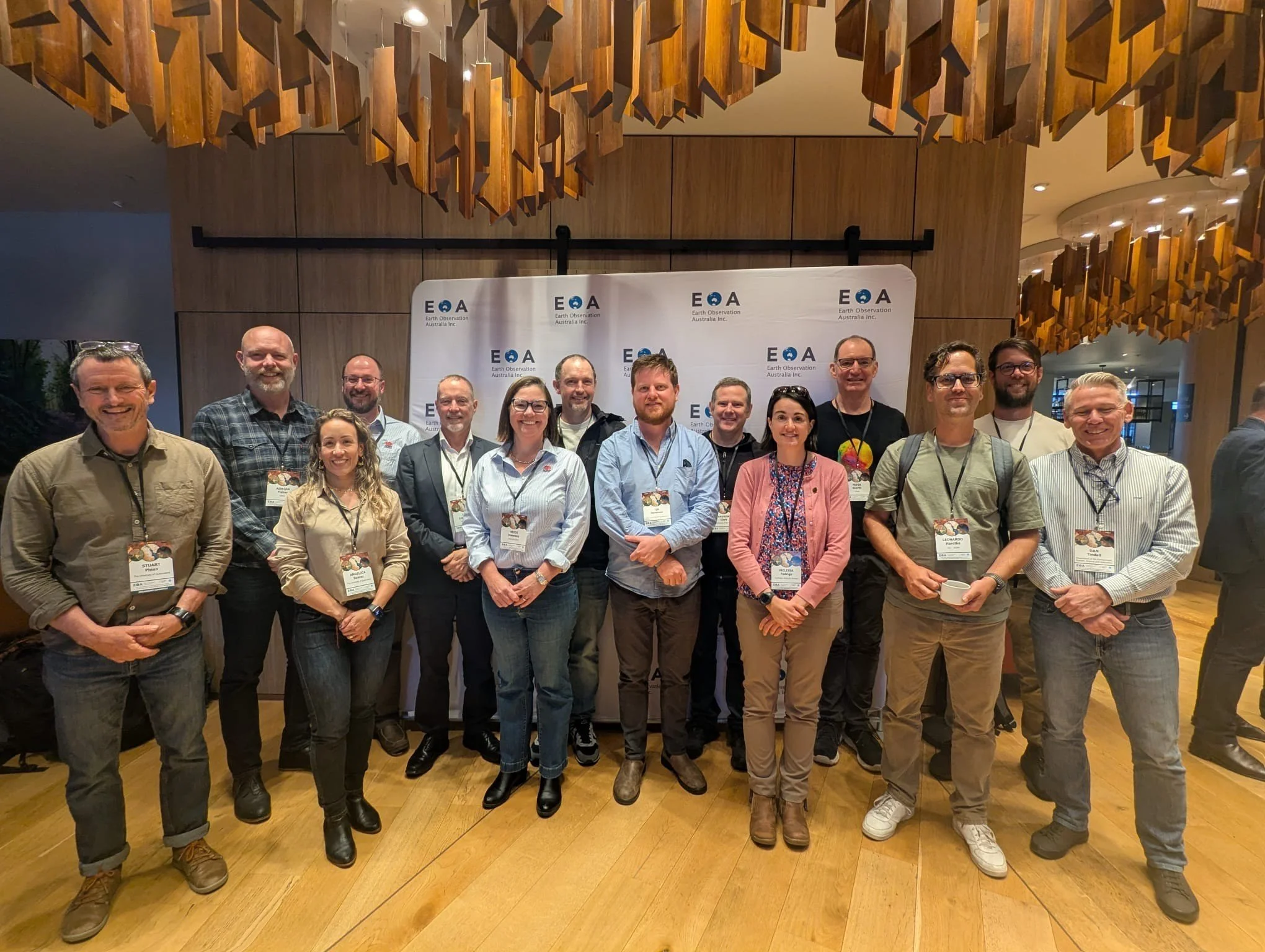
EORC and JRSRP staff together with partner staff from the Queensland and New South Wales Governments, the University of New England (UNE), and the University of New South Wales.
Researchers and students from the Earth Observation Research Centre (EORC) and Joint Remote Sensing Research Program (JRSRP) were well represented at the Advancing Earth Observation (AEO) Forum 2026, held in Hobart, Tasmania from 9-12 November.
Hosted by Earth Observation Australia, the forum brought together participants from industry, government, research, defence, education and not-for-profit organisations under the theme "Sovereign Capability, Global Impact." The event highlighted the growing importance of Earth observation technologies in addressing national and global challenges, including environmental monitoring, disaster resilience, food and water security, climate adaptation, and natural resource management.
Key themes emerging from the forum included:
Artificial intelligence and foundation models for Earth observation
Cloud-native geospatial technologies and large-scale Earth observation data processing
Earth observation applications for vegetation, forests, agriculture and carbon monitoring
Water quality, coastal and marine ecosystem assessment
Hyperspectral and Synthetic Aperture Radar (SAR) capabilities
International collaboration and emerging satellite missions
Developing Australia's sovereign Earth observation capability while contributing to global environmental challenges
The strong participation from EORC and JRSRP demonstrated the diversity of expertise across our community and showcased leading research in remote sensing, environmental monitoring and Earth observation applications.
EORC and JRSRP Presentations
Forum Presentations
Vegetation monitoring in NSW - Evolution of EO capability, legislative requirements and resulting challenges (Tom Celebrezze)
A spectral translator that takes Landsat → Sentinel-2, for vegetation studies in Australia (Matthew Pringle, James Brinkhoff, Andrew Clark, Andrew Robson (AARSC UNE) Tom Bishop (USYD))
Block-Level and Multiple Instance Learning Workflows for Tree-Crop Yield Prediction (Andrew Clark)
Comparison of 3D Models of Reef Island Shorelines Derived from Lidar and SfM Photogrammetry (Maria Kottermair)
Developing repeatable EO based products for Australia, and challenges for national scale reporting data infrastructure (Mitchell Lyons)
Building Trust In Satellite-Derived “Vegetation” Products for Monitoring and Managing Vegetation Across Scales in Australia (Stuart Phinn)
Mapping Australian kelp forests using satellite Earth Observation (Gillian Rowan)
Delivering Continental-Scale Pasture Monitoring: Validation and Adoption Lessons from the Australian Feedbase Monitor (Peter Scarth)
Mapping of live coral cover using hyperspectral satellite imagery (Joanna Smart, Mitch Lyons, Stuart Phinn, Chris Roelfsema)
Thirty years of the Statewide Landcover and Trees Study (SLATS) in Queensland, Australia (Dan Tindall)
Poster Presentations
Segfix: find and fix tree segmentation errors in forest point clouds, Tree-by-tree review of tree IDs, leaf–wood labels and links to field inventory (Tim Devereux, Josh Rivory, Will Woodgate, Raja Ram Aryal, Glen Eaton, Stuart Phinn)
Monitoring Regrowth of Woody Vegetation a NSW Perspective (Geoff Horn, Anthea Mitchell, Tim Danaher, Heidi Mawbey)
Mapping Australian Kelp Forests with EO: a How‐To Guide, Research design & pipeline development (Gillian Rowan)
Locating historical aerial photography with Phloc (Jim Watson, David Black)
Spatio-Temporal EVI Difference Index (Jim Watson, Justin Ryan)
True-to-life forest reconstructions from terrestrial and drone LiDAR: How close are we to automatically turning a forest point cloud into a structurally and radiatively realistic 3-D forest? (William Woodgate, Tim Devereux, Raja Aryal, Glen Eaton, Joshua Rivory, Rafael Bohn Reckziegel, Stuart Phinn, Shaun Levick, Tom Lowe)
Satellite Derived Vegetation Products (SDVP) Workshop
JRSRP also contributed to the workshop program through the Satellite Derived Vegetation Products (SDVP) Community of Practice Workshop, hosted by Professor Stuart Phinn. The workshop brought together researchers, government representatives and industry practitioners to discuss current approaches, challenges and opportunities in the development and application of satellite-derived vegetation products.
Building on the Community of Practice established in 2025, participants explored opportunities for collaboration, knowledge sharing and the advancement of consistent, operational vegetation monitoring products across Australia. The session highlighted the importance of translating Earth observation science into practical information products that support environmental management, monitoring and policy decisions.
The AEO Forum continues to provide a valuable platform for collaboration across the Australian Earth observation community, and the strong contribution from JRSRP and EORC reflects our ongoing leadership in advancing Earth observation research and applications.